
Public health programs
The Tick Program
The Tick Program serves as the Island's collaborative initiative for reducing the burden of tick-borne diseases and tick-associated allergies.
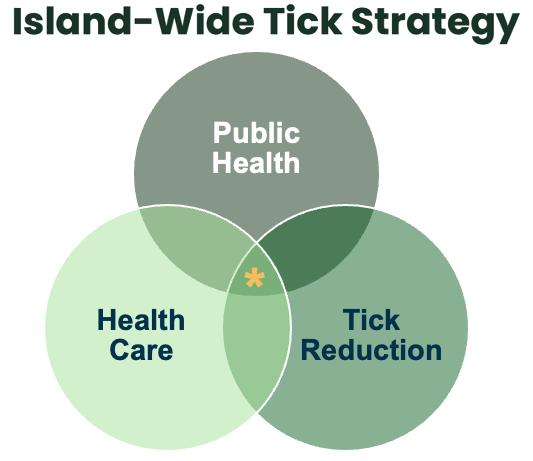
Established in 2011 through a Martha's Vineyard Hospital grant and a partnership of Martha's Vineyard's six Boards of Health, scientists, and healthcare providers, the program serves as the connective tissue between public health, healthcare, and tick reduction—helping ensure that each informs and strengthens the others.
We like to say that we bring science to the community—and community to the science. That philosophy guides everything we do, from tick surveillance and epidemiology to healthcare partnerships, research, education, and community engagement. By connecting scientists, clinicians, public health professionals, and residents, we translate research into practical action while ensuring that community needs continue to shape scientific discovery.
Previously known as the Martha's Vineyard Tick Program, in 2021 the program expanded under the Inter-Island Public Health Excellence Collaborative to include Nantucket and Gosnold. It serves as the scientific and public health foundation for an evidence-informed, community-driven approach to reducing tick-borne diseases on the islands.
About the Tick Program
What We've Accomplished
Since 2011, the Tick Program has:
-
- Raised awareness of tick ecology, wildlife host dynamics, and evidence-based strategies to reduce tick populations
- Educated residents and visitors about how to prevent tick bites
- Helped homeowners reduce tick bites in their own backyards through hundreds of residential tick risk assessments
- Established robust tick surveillance which documented the establishment and spread of lone star ticks
- Partnered with hunters and community organizations to develop the Island Deer Cooler, removing barriers to deer harvest and supporting deer management as a long-term strategy to reduce deer and lone star tick populations.
- Launched first-in-the-state alpha-gal syndrome surveillance, and raised awareness of alpha-gal syndrome locally and nationally
- Built partnerships with local, state, and national experts
- Contributed to science via publications, speaking at conferences, and sharing best practices
- Supported healthcare providers with education resources, local disease trend data, and connection to experts
- Informed public health policy in Massachusetts, including making Alpha-gal syndrome a reportable condition (see the Declaration here)
History of the Tick Program
Martha's Vineyard has long experienced one of the highest burdens of tick-borne diseases in Massachusetts. Long before the emergence of alpha-gal syndrome (AGS) and the rapid expansion of the lone star tick, Islanders grappled with American dog ticks (previously called wood ticks) and blacklegged (deer) ticks that transmit infectious diseases including Lyme disease, babesiosis, anaplasmosis, tularemia, Rocky Mountain Spotted Fever, Borrelia miyamotoi, and Powassan virus.
The program began with grant support from Martha's Vineyard Hospital and brought together local health officials, physicians, scientists, conservation organizations, and community leaders. From its inception, the program was designed to be more than a public education campaign. It combined disease and tick surveillance, research, environmental assessment, medical education, and community outreach into a comprehensive public health strategy. Early leaders included Dr. Michael Loberg, owner of Vineyard Medical Care; Matthew Poole, Edgartown Health Agent; Richard ("Dick") Johnson, biologist and field leader of many of the program's surveillance and outreach efforts; Dr. Sam Telford of Tufts University; and representatives from all six island Boards of Health.
During its first five years, the program developed educational materials for residents and visitors, introduced tick-borne disease curricula into Island schools, created one of the region's first locally focused tick-borne disease websites, conducted community surveys and serologic studies, evaluated environmental risk factors, and explored strategies to reduce human exposure to ticks. The program also pioneered Portuguese-language outreach efforts to better serve Martha's Vineyard's Brazilian community.
The Martha's Vineyard Tick Program embedded scientific expertise directly within the community. Residents could speak with scientists in their own backyards, healthcare providers had direct access to researchers, and emerging scientific discoveries were rapidly translated into practical guidance for the public. The program was also unusual in its emphasis on collaboration. Rather than operating through a single organization, it brought together all six island Boards of Health, physicians, researchers, conservation organizations, educators, and community members around a shared public health challenge. This collaborative model remains one of the defining characteristics of the program today.
As the tick landscape evolved, so did the program. Through long-term tick surveillance, the program documented the arrival, establishment, and subsequent expansion of lone star ticks across Martha's Vineyard. These observations helped identify an emerging public health threat years before alpha-gal syndrome became widely recognized in Massachusetts. The program expanded its focus to include surveillance and education related to a broader range of tick-borne illnesses and tick-associated conditions. More recently, the Island Boards of Health and Martha's Vineyard Tick Program contributed to statewide discussions and advocacy efforts that helped lead to alpha-gal syndrome becoming a reportable condition in Massachusetts, improving the Commonwealth's ability to monitor an emerging public health issue.
More than a decade later, many of the same principles outlined in the original 2011 proposal—surveillance, education, research, environmental assessment, healthcare engagement, and community partnership—continue to guide efforts to reduce the burden of tick-borne diseases and alpha-gal syndrome on Martha's Vineyard.
The Program Today
Today, the Tick Program is staffed by tick and deer biologist Patrick Roden-Reynolds and epidemiologist Lea Hamner. The program serves as a collaborative public health initiative dedicated to reducing the burden of tick-borne diseases and tick-associated allergies on Martha's Vineyard.
The program works closely with local, regional, state, and national partners to advance surveillance, education, prevention, research, and community engagement. Consistent with the program's founding mission, its work integrates ecology, epidemiology, healthcare, and public health to better understand and reduce disease risk.
Today, the program continues to operate under the same philosophy established in 2011: combining ecology, epidemiology, healthcare, and community engagement to reduce disease risk through evidence-informed, locally grounded public health practice.
Current activities include:
- Community education on tick ecology, tick bite prevention, tick-borne diseases, and alpha-gal syndrome
- Surveillance of tick populations, tick-borne diseases and allergies, and emerging public health threats to guide evidence-based interventions
- Residential tick risk assessments and homeowner consultations focused on reducing tick exposure in yards and landscapes
- Hunter retention initiatives and operation of the Island deer cooler to support deer management efforts
- Support for healthcare providers through data sharing, education, and collaboration. Healthcare provider education and continuing education through partnerships with local clinicians and nationally recognized experts in tick-borne diseases and alpha-gal syndrome.
- Applied research partnerships supporting studies in tick ecology, infectious diseases, allergy, epidemiology, and community-based intervention strategies.
- Community support through a monthly Alpha-gal syndrome support group
- Collaboration with academic researchers studying tick ecology, infectious diseases, allergy, wildlife management, and public health
- Scientific support for Tick Free Martha's Vineyard and other community initiatives working to reduce ticks in the environment
- Documenting a comprehensive island-wide tick strategy with three interwoven pillars of public health, healthcare and tick reduction.
Collaborators
The Martha's Vineyard Tick Program actively collaborates with a broad range of organizations.
Government:
- Martha's Vineyard’s six town Boards of Health: Aquinnah, Chilmark, Edgartown, Oak Bluffs, Tisbury, West Tisbury
- Town of Gosnold Board of Health
- Town of Nantucket Board of Health
- Dukes County
- Massachusetts Department of Public Health
- Massachusetts Division of Fisheries and Wildlife (MassWildlife)
Tick Reduction:
Healthcare:
- Martha's Vineyard Hospital
- Martha’s Vineyard Medical
- Island Health Care
- Pill Clarity
Research:
- New England Center of Excellence in Vector-Borne Diseases (NEWVEC)
- University of Massachusetts Amherst
- Mass General Brigham
- Tufts University Telford Lab
- University of North Carolina Chapel Hill Commins Lab
Alpha-gal syndrome:
And other regional, state, and national public health, healthcare, research, and conservation partners.
Publications & Conferences
Publications
- Johnson RW, Roden-Reynolds P, Snow AA, Rich SM. The Spread of Lone Star Ticks (Amblyomma americanum) and Persistence of Blacklegged Ticks (Ixodes scapularis) on a Coastal Island in Massachusetts, USA. Insects. 2024;15(9):709.
Conferences
- First Annual Alpha-gal Syndrome Scientific Meeting. Lea Hamner. "Turning Up the Heat: Alpha-Gal Syndrome, Lone Star Ticks, and Rapid Change on Martha’s Vineyard." Raleigh, NC. July 7-8, 2026.
- National Association of City and County Health Officials Annual Meeting. Patrick Roden-Reynolds & Lea Hamner. "The Martha's Vineyard TIck Program: An evidence-informed, community-driven public health response to a complex crisis." Louisville, KY. July 14-17, 2026
- Massachusetts Health Officer Association Annual Meeting. Patrick Roden-Reynolds & Lea Hamner. “Tick Talk: Spreading the Word Before the Bite.” Springfield, MA. November 5, 2026
- Massachusetts Health Officer Association Annual Meeting. Lea Hamner. “Alpha Gal Syndrome: Tracking & Tackling a New Tick Epidemic on Martha’s Vineyard.” Springfield, MA. November 13, 2026
Additional publications, reports, presentations, and educational materials will be added as they become available.
Media Coverage
The Martha's Vineyard Tick Program has been featured in local, regional, national, and international media coverage related to tick-borne diseases, alpha-gal syndrome, wildlife management, and public health. Selected media coverage and interviews will be added to this page.
Local Media
Vineyard Gazette, near weekly coverage, select articles
-
- Scientists Look to Chappy in Fight Against Ticks, July 16 2026
- Alpha-Gal Is Not Only a Vineyard Issue, op-ed by Lea Hamner, July 9 2026
- Governor Pledges Support in Fight Against Ticks, June 25 2026
- RFK Invokes the Vineyard in New Tick-Borne Illness Effort, June 2 2026
- January is Tick Prevention Season, op-ed by Lea Hamner, February 5 2026
- Can the Spread of Ticks Be Abated?, July 3 2025
- Alpha-Gal Cases Skyrocket as Lone Star Ticks Dig in, October 31 2024
- Lone Star Ticks Continue to Make Inroads Around the Island, September 26 2024
Martha’s Vineyard Times, near weekly coverage
-
- Running a kitchen in alpha-gal times, May 6 2026
- Recordings of ticks and tick-borne-disease programs available, February 11 2026
- Building community around alpha-gal, July 26 2024
- Disease prevention, deer population reduction focus of Island tick forum, June 13 2023
- Tick program heeds warning about lone star tick, February 15 2023
- Lone star ticks emerge early this year, April 25 2021
Blue Dot Living
-
- Climate Champ: Patrick Roden-Reynolds, June 17 2025
Martha’s Vineyard Magazine
-
- An Island Epidemic, June 6, 2025
- Tick, Tick, Boom, August 24, 2022
- Tick Talk, April 29 2022
National Media
The Atlantic Magazine
- “Kill the Ticks.” August 3, 2026
New Yorker Magazine
- “The Tick That Hunts Down Its Hosts—Including Us” June 29, 2026
NPR
- Fresh Air with Terry Gross and Burkhard Bilger, Lone star ticks are covering much of the U.S. Here's what you need to know, July 1 2026
- Morning Edition, Tick season is getting worse. Can managing deer help?, June 19 2026
- All Things Considered, Ticks surge in the Northeast, June 15 2026
The Boston Globe
- Advocates push to make alpha gal the 10th major food allergen, July 20 2026
- Alpha gal has profoundly changed life on Martha’s Vineyard. Just look at the restaurants, June 25 2026
- No red meat, no dairy, and no end in sight: How a tick-borne allergy has transformed Martha’s Vineyard, June 5 2026
New York Times
CNN
- Tickborne Food Allergy Surging on Martha’s Vineyard, May 28 2026
- Tick bites are changing the menu on this island, May 30 2026
GBH Curiosity Desk
- Why Are "Ticked Off" Meat-Lovers Going Vegan?, April 8 2026
International Media
Tick-Borne Illness Resources
Identify Tick Species
Types of Ticks on the Islands
Lone Star Tick
Common on the Islands
Alpha-Gal Syndrome
Learn About AGS
Public Presentations
Browse Tick Presentations
Video Resources
Informative Tick Videos
Yard Surveys
Residential Yard Surveys